A History of Croquet
In the Beginning there was…
Ball and mallet games are among the oldest organized sports known to human history. One of the earliest recorded ancestors of croquet is Paganica (also known as Pila Paganica), a Roman ball and mallet game believed to have been brought to Britain by Roman legions during their occupation, which lasted from the 1st through the 5th century. Paganica involved striking a leather-wrapped ball with a curved stick and laid the conceptual foundation for later mallet games.
Another early form was Cambuca, a game once popular in Britain and dated by various sources anywhere from the 12th to the 14th century. Cambuca is thought to be a later derivative of Paganica. The name itself comes from Latin, meaning "crooked bow or stick," a direct reference to the curved implements used to strike the ball.
While there is no traceable path from Paganica or Cambuca to the 19th century game French historians trace a continuous line of development through jeu de mail, a ball and mallet game widely known and practiced in France from at least the 11th century. According to croquet historian Anthoine Ravez of the Fédération Française de Croquet, jeu de mail was borrowed by the British around 1300 and modified over centuries. From this shared lineage, the Scots eventually developed golf, the Irish refined croquet, and even billiards emerged when Louis XIV, unable to play mail outdoors in winter, miniaturized the game for indoor tables.
Origins of Modern Croquet
Current historical thinking places the immediate origins of modern croquet in Ireland in the early 1800s, where it was called "Crooky" (also spelled crookie). although there are strong indications, especially linguistic ones, that the game's roots lie on the European continent. One likely predecessor was Pall Mall, a game played by royalty in the 15th and 16th centuries using wooden balls and mallet-like implements. The objective was to play the ball down a prepared alley and through an iron hoop in the fewest strokes. Pall Mall was fashionable at royal courts, and its name likely derives from the Italian palla maglio, meaning "mallet ball."
What is firmly established is that the first standardized croquet set was manufactured in 1850 by Jaques of London, and the modern history of croquet is inseparable from the Jaques (pronounced "Jakes" in the UK) family, who still sell croquet equipment.
Jaques of London and the Codification of the Game
The Jaques story begins around 1790, when Thomas Jaques, a French Huguenot immigrant and skilled craftsman, found employment in London with a firm owned by a man named Ivey. The business specialized in fine woodwork, ivory, bone, and Tunbridge ware, delicately inlaid wooden boxes. Thomas soon married Ivey's niece, took over the firm, and apprenticed his fifteen-year-old son, John Jaques.
John proved exceptionally talented. By the 1830s, Jaques of London had become one of the largest producers of games in the world, along with a wide range of other precision-crafted products. In 1850, John Jaques observed crooky being played in Ireland using crude mallets and improvised equipment. Recognizing its potential, he returned to London and produced the first commercially manufactured croquet set and a rule book, effectively standardizing the game.
Jaques croquet sets were quickly adopted by royalty, and croquet won two medals at the Grand Exposition of 1851. The game spread with extraordinary speed. By the 1860s and 1870s, croquet was being played seemingly everywhere, and by the 1880s it had spread worldwide, with Jaques of London serving as the principal supplier.
Croquet in Culture and Literature
>
A cultural connection links croquet to literature through John Tenniel's illustrations . John Jaques II had commissioned Tenniel to draw the original illustrations for the Happy Families card game (invented by Jaques) released in 1851 (and still sold by them today). John Tenniel was already an established artist, steeped in mid-Victorian visual satire. Before Alice, he was the principal cartoonist for Punch, where he joined in 1850 and became chief cartoonist in 1864.
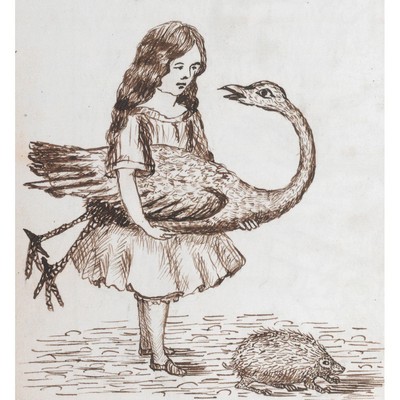
In 1864 Tenniel was commissioned to illustrate Lewis Carroll's Alice's Adventures in Wonderland (published in 1865). While Tenniel had considerable artistic freedom in his interpretations, Carroll produced sketches for all the images and maintained tight control of the project and had Tenniel alter illustrations several times when dissatisfied. The famous croquet scene in Chapter VIII, where Alice plays with flamingo mallets and hedgehog balls, became one of Tenniel's most memorable illustrations and is taken directly from Carroll’s sketch shown here. Tenniel's detailed black-and-white drawings remain the definitive depiction of Alice's adventures.
Croquet’s Arrival and Rise in the United States
Croquet crossed the Atlantic in the mid-19th century, arriving in the United States during a period of intense interest in leisure, refinement, and outdoor recreation. According to an 1863 newspaper advertisement, croquet may have been introduced to America as early as 1861, though it came into widespread use in 1863. By the late 1850s and early 1860s, croquet sets were being imported in significant numbers, and some of the earliest dedicated croquet lawns appeared in affluent coastal communities of the Northeast.
Calling itself the 'pastime of the age,' the game spread rapidly through private estates, seaside resorts, women's colleges, and suburban lawns. One of croquet's great social innovations was that it allowed men and women to compete together on equal terms, making it one of the first mixed-gender outdoor sports in American life.
Soon croquet had exploded across the country. Clubs had sprung up from New England to the Midwest, and rule variations were proliferating wildly. Recognizing the need for order, representatives from clubs gathered in New York to standardize rules, organize competition, and legitimize croquet as a serious sport rather than a parlor diversion.
The first true national governing body for croquet in the United States was the National American Croquet Association (NACA), formed in 1882. According to period records, approximately 25 clubs from the New York area were involved in organized competitions under NACA's governance.
NACA succeeded, briefly. It:
• Published standardized American rules
• Sanctioned interclub matches and championships
• Promoted six-wicket croquet as the "proper" form of the game
Moral Concerns and Public Reaction - Banned in Boston!
That very eagerness and openness soon generated controversy. By the 1870s and 1880s, croquet had developed a reputation for accompanying questionable behavior. It was rumored that young women would intentionally knock their balls into shrubbery so they could disappear behind the rhododendrons to flirt with young men under the pretext of retrieving the balls.
In the 1890s, the Boston clergy spoke out publicly against the drinking, gambling, and licentious behavior associated with croquet on Boston Common. An 1898 magazine editorial declared croquet "the gaping jaw of Hades" and called for clergy and laity to suppress "the immoral practice of croquet." Another magazine called it “a source of slumbering depravity, a veritable Frankenstein monster of recreation.” Oh my!
While Boston banned it from Boston Common and some other municipalities (including Martha’s Vineyard) discouraged or restricted public croquet during this period, these reactions reflected broader Victorian anxieties about public behavior and mixed-gender socializing rather than anything inherent to the game itself.
Croquet at the Olympics
Despite these concerns, croquet appeared on the 1900 Paris Olympics program where singles one-ball, singles two-balls, and doubles were contested. Only ten athletes (7 men, 3 women) competed, all of whom were from France. The tournament is notable for having attracted only a single paying spectator—an elderly English gentleman who traveled from Nice for the early stages of competition. Not surprisingly,France won all the medals and remains the current title holder should croquet ever return to the Olympics.
Decline with the Rise of Lawn Tennis
Croquet's popularity began to fade with the rise of lawn tennis, a faster, more athletic sport better suited to competition and spectatorship. The symbolic center of this transition was Wimbledon. Originally the All England Croquet Club, founded in 1868, it hosted the first Wimbledon tennis championship in 1877. Within a few years, tennis had largely displaced croquet. The club's name was changed to the All England Lawn Tennis Club in 1882, but in 1899 it was restored to the All England Lawn Tennis and Croquet Club out of sentiment, though only a single croquet lawn remains today.
The decline in croquet hurt equipment manufacturers, including Jaques of London. John Jaques II began to manufacture standardized equipment for the game of "table tennis." The game had been informally created in the 1880s as an off-season dining table game by upper class tennis players. After the celluloid ball was introduced in 1901, he standardized equipment and rules for a commercial version of the game, registered "ping pong" as a trademark in the UK that year, and played a significant role in popularizing the game.
American Adaptations: Backyard Croquet and Roque
In the United States, croquet survived by transforming. While much of the world continued to play six-wicket croquet, Americans embraced a simplified version known as nine-wicket or backyard croquet. This became the version most Americans encountered, a staple of family gatherings, college lawns, and summer celebrations. In practical terms, backyard croquet relates to six-wicket croquet much as checkers relates to chess.
Americans also experimented with alternatives. One notable offshoot was roque, a distinctly American adaptation played on hard clay courts with sideboards (similar to bocce courts), smaller mallets, and heavier balls. The name "roque" was suggested in 1899 by Samuel Crosby of New York City, who arrived at it by removing the initial "c" and final "t" from "croquet." The National Croquet Association, which had been formed in 1882, changed its name to the National Roque Association in 1899.
Roque enjoyed a period of popularity around the turn of the 20th century and was contested at the 1904 Olympic Games in St. Louis—a curious and often forgotten chapter in the history of mallet sports. Since all competitors were American, the United States won all the medals
American Croquet Cliques
Croquet remained visible in American culture through the early 20th century and Hollywood's Golden Age (1930s and 40s).
The most famous era of celebrity croquet centered around producer Samuel Goldwyn and his "croquet clique." This group took the game obsessively seriously, often playing for high stakes on meticulously maintained lawns. The legendary producer installed two championship-level courts at his estate. He was known for being a terrible loser and for banning people from his home if they beat him too badly.
Among the enthusiasts were W.C. Fields and Harpo Marx. The latter was a self-described "croquet maniac" who was inducted into the United States Croquet Hall of Fame in 1979. He was known as a "croquet evangelist" who taught his brothers and many others to play.
Literary figures associated with the Algonquin Round Table also indulged in croquet, reinforcing the game's association with wit, leisure, and social sophistication. Critic Alexander Woollcott Invited the members of the Algonquin Round Table to Neshobe Island, in Lake Bomoseen in Vermont (most of which he had purchased), where croquet was a mandatory religion. The Neshobe group is credited with popularizing—and some say inventing—the most cutthroat version of American rules, specifically Carry-Over Deadness.
These included Dorothy Parker, who reportedly played with "unsportsmanlike rivalry" and a competitive streak that matched her biting wit. George S. Kaufman, the playwright (You Can't Take It With You), was a regular at croquet gatherings where the game was taken quite seriously.
The island had a strictly enforced "no clothes required" policy, which extended to the croquet lawn. Harpo Marx and Dorothy Parker often played entire matches completely naked (save for a hat).
Revival and Modern Organization
By mid-century, serious croquet had become a niche activity. Its revival began in 1960 with a highly publicized match between the Westhampton Mallet Club of New York's Hamptons and London's Hurlingham Club. The match, which played to a draw under American rules after Westhampton had been defeated under British rules in 1959, reignited interest in traditional six-wicket croquet in the United States and reconnected American players with international standards.
In 1977, Jack Osborn organized the United States Croquet Association, initially bringing together six East Coast clubs: the Croquet Club of Bermuda, Green Gables Croquet Club, New York Croquet Club, Palm Beach Croquet Club, and Westhampton Mallet Club. A standardized set of American six-wicket rules was adopted, closely related to international rules but with subtle differences. Organized croquet began to grow steadily once again.
Earliest American Clubs
In the 19th century most croquet lawns were on the private estates of the wealthy, but several were established for the public to use.
• Park Place Croquet Club (Brooklyn), organized in 1864, is recorded as the country's first croquet club. Its lawns have long since been absorbed by the urban development of Brooklyn.
• The Newport Casino (Newport, Rhode Island) - Est. 1880 is probably the most historically significant lawn still in use. When James Gordon Bennett Jr. founded the Newport Casino (now the International Tennis Hall of Fame) in 1880, it was a social club designed for the Gilded Age elite. The grounds were originally laid out for archery, lawn tennis, and croquet. It is one place in the US where you can play on grass courts that have been in continuous operation for nearly 150 years.
.
Croquet Today
Today, the United States Croquet Association which has nearly 300 member clubs and 3,000 individual members estimates there are 600 venues and about 5,000-10,000 people regularly playing organized croquet in the United States and Canada. The USCA is headquartered at the National Croquet Center in West Palm Beach, Florida, on a ten-acre campus featuring Twelve full-sized championship croquet courts, two practice courts, and a nine-wicket regulation court as well as a 19,000 square foot clubhouse. The facility opened in February 2002 and is named the Charles P. Steuber National Croquet Center. Free lessons are offered regularly, reflecting the organization's emphasis on accessibility and growth.
American players have become increasingly competitive internationally, with top players now adept in both American Rules and International Rules (Association croquet). Americans have finished as high as second and third in recent years in World Croquet Federation Championship events and other prestigious international competitions.
Croquet in the United States occupies a distinctive niche: too small to commercialize, too organized to disappear, and remarkably resilient. It endures because it rewards precision, patience, strategy, and social intelligence—qualities that remain timeless even as the world around the game continues to change.
R.V. Walsh is solely responsible for any errors and omissions herein.